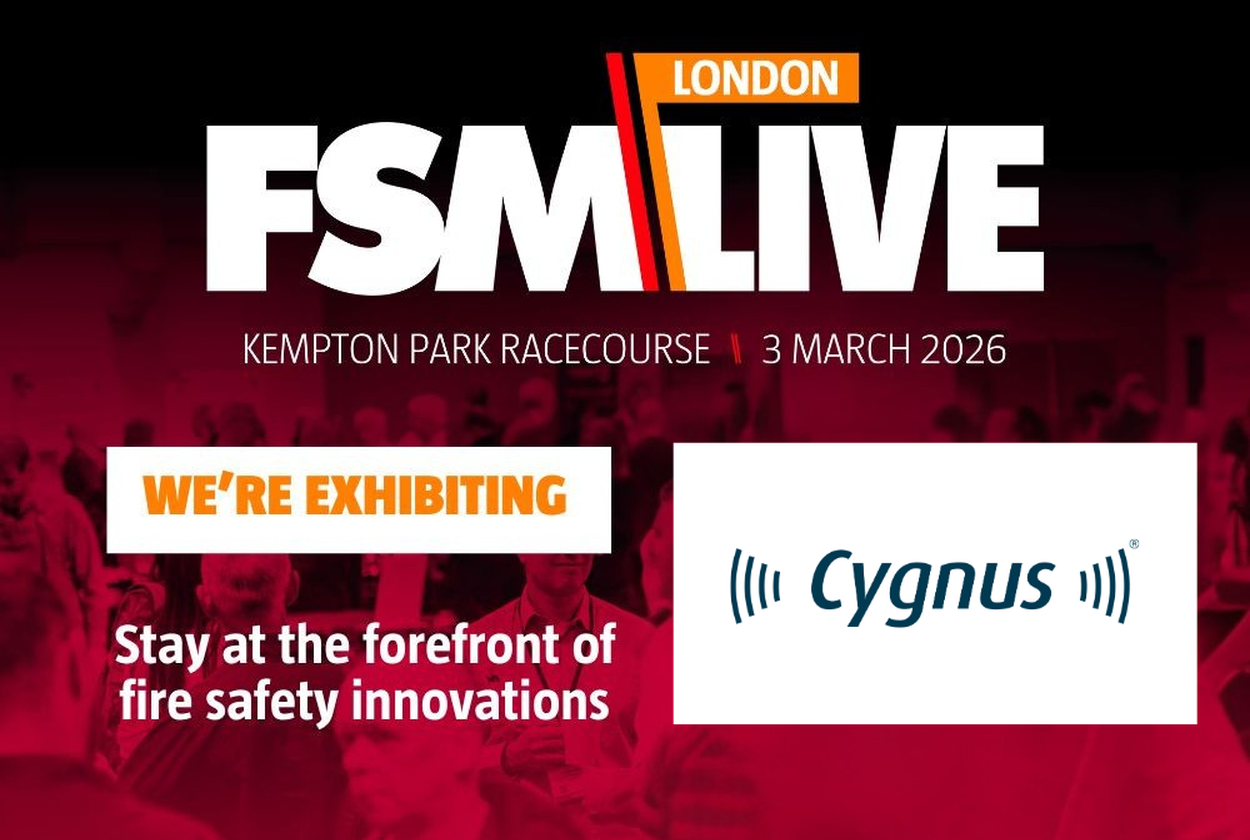
We will be exhibiting at Fire Safety Matters Live London on 3rd March 2026 at Kempton Park Racecourse, and we would love to see you there.
What to expect from Cygnus
- Live demonstrations of our true wireless fire detection and alarm systems
- Expert guidance on Gateway Two compliance challenges
- Practical Waking Watch replacement strategies for occupied buildings
- Advice on scalable, low-disruption fire safety upgrades
- Direct access to our technical team to discuss your project
Join us at Fire Safety Matters Live 2026
Register for free and read our latest blog ahead of the event.
See true wireless fire detection and alarm systems in action
Built for scale and complexity, Cygnus systems deliver true wireless performance at a scale never thought possible. With MeshBeyond technology, our systems self-form and self-heal, supporting stable communication that rivals wired systems.
Cygnus is designed for fast-moving environments where access is limited, layouts change, or disruption must be kept to a minimum. And with zero wires beyond the control panel, installation is simpler and easier to adapt.
MeshBeyond technology enables Cygnus systems to self-form and self-heal, helping maintain reliable communication as sites and buildings evolve.
We will also be showcasing our proprietary control panel, designed to be easy to use, making setup and system management straightforward.
Gateway Two challenges and Waking Watch replacement strategies
We will be discussing Gateway Two challenges and Waking Watch replacement strategies with visitors on the day. As compliance expectations evolve, responsible persons and project teams need practical options that support safer outcomes without adding complexity.
Replacing a Waking Watch?
Learn how Cygnus can support a scalable, compliant alternative to a Waking Watch with true wireless fire detection designed for occupied and complex buildings.
Topics we can discuss
- Navigating Gateway Two requirements and project timelines
- Replacing a Waking Watch with a compliant, scalable alternative
- Upgrading fire detection in occupied or complex buildings with minimal disruption
- Improving coverage across changing layouts or hard-to-access areas
- Deploying a system that is easier to manage across multiple sites